
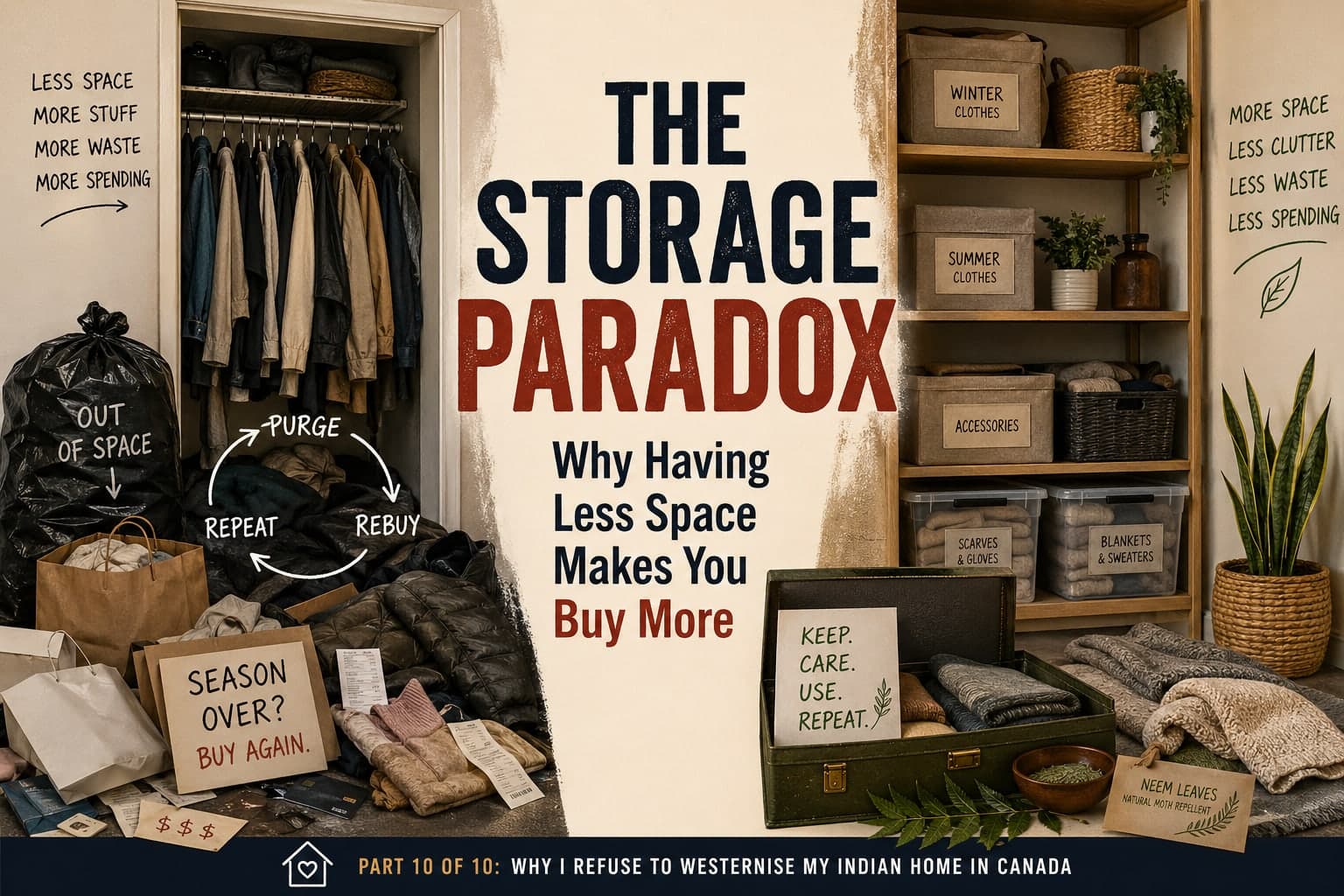
This blog is the 10th in the series of 10 blogs on Why I Refuse to Westernise My Indian Home in Canada.
Shouldn’t limited space mean buying less?
But that’s not how it works in Canadian homes, especially in Toronto apartments. The opposite happens. You buy more, throw away more, and rebuy the same things seasonally, all because your bedroom closet is the size of a shoebox.
This is the storage paradox. And once you see it, you can’t unsee it.I realised it this week, while stuffing my winter coat into a corner, deciding what to discard to make room. My parents’ three-bedroom home in India has more storage space than my entire Toronto apartment. Not because it’s a mansion. Because someone actually planned for things to exist beyond this season. Canadian homes, meanwhile, seem designed with the opposite philosophy: keep it minimal, and people will naturally consume less. Spoiler: that’s not what happens.
How Scarcity Creates Consumption
Ofcourse, every season change comes with its own home and wardrobe improvement needs. My life back in my home country was all about opening the store room and getting the seasonal stuff out. What does it mean in Canada? As the season changes, people discard previous season items in the bins and make room to buy new stuff.
Here’s where the paradox kicks in: six months later, when you need those items again, they’re gone. So you buy replacements.
This isn’t about wanting new things. This is about not having the space to keep what you already own. Your limited storage didn’t save you from consumption. It forced you into a consumption cycle.
The system works backwards. Lack of space means:
- Seasonal purging (because you have nowhere to keep things)
- Seasonal re-buying (because you threw them away)
- Constant churn (because the cycle repeats)
- More waste (because nothing lasts more than a season or two)
The Economics of this Paradox
I started tracking this last year, not because I’m obsessive (okay, maybe a little), but because something felt off about my shopping patterns. Every September, I’d buy new winter clothes. Every May, new summer gear. I’d tell myself I “needed” these things. But the truth? I was buying them because I’d thrown away the ones from last year to make room for current-season items.
The paradox means you’re not just buying one wardrobe. You’re buying multiple versions of the same wardrobe across your lifetime. Winter coat at 25. Winter coat at 27 (the old one didn’t fit in the closet). Winter coat at 29. Winter coat at 31. Four coats. Same climate. Same purpose. Different only because your home has nowhere to keep one coat across eight years.
The math is brutal:
- 2–3 seasonal wardrobe replacements per person per year (because you discarded the last one)
- A family of four? That’s roughly 8–12 unnecessary purchases annuallyMultiply that across decades, across millions of Canadian households
We’re not just talking about your wallet. A family could save $500–1,000 annually by keeping what they already own instead of constantly replacing it. We’ve normalised it so completely that we think it’s a personal shopping problem. (“I buy too much.” “I need to be more minimalist.” “Maybe I don’t need new clothes.”)No. You have a storage problem that’s forcing a consumption problem.
Why I Felt The Need To Write This
I come from a place where there is a designated room with shelves, boxes, and a system, which we call the Store Room. Winter clothes go into cotton storage bags with neem leaves (a natural moth repellent). They stay folded, protected, waiting the entire summer. When October arrives, we don’t buy new sweaters. We open those boxes.
Was it boring? Absolutely. Was it practical? Incredibly.
Storage isn’t a luxury. It’s infrastructure. You plan for the future because you expect to have the same objects in it. Canadian homes are designed with the assumption that you’ll rebuy everything constantly. Minimal closets, no attics in newer condos, basements that flood, and no dedicated storage areas. It’s as if the architecture itself is nudging you toward consumption.
The Environmental Consequences
A cotton t-shirt takes about 2,700 litres of water to produce. A winter coat requires petroleum-based materials and global supply chains. Each time you cycle through these items, discarding and buying replacements, there’s a carbon cost embedded in the manufacturing, shipping, and disposal.
The fashion industry accounts for roughly 92 million tons of textile waste globally per year. The average person throws away 81 pounds of clothing annually.
So it isn’t just about your closet. It’s about whether we, as a society, have decided that it’s normal and acceptable to manufacture waste at scale because our homes don’t have proper storage.
What You Can Do (Without Moving Houses)
Here's what I figured can still, actually work:
- Vertical storage: Wall-mounted shelving, under-bed organisers, vacuum storage bags. Not glamorous, but they work. I have a bedroom wall that's now 80% shelving. It's not Instagram-pretty, but I can store what I need.
- Off-season rotation: Commit to a system. Winter clothes go into labelled bins. Summer clothes come out. It will consume the whole weekend in spring and fall, but you're not constantly shuffling. You're managing a cycle.
- Invest in proper storage: Don't cheap out on bins or storage solutions. Moisture-resistant containers, breathable bags for fabric storage, cedar or neem-based natural repellents. If you're keeping clothes for eight months, they need protection.
- Rethink seasonal shopping: This is the hard part, the cultural shift. You don't need a whole new wardrobe. You need what you already own back in circulation.
Your home doesn't need to change overnight. But recognising the paradox? That changes how you see every purchase, every season, every time you're forced to choose between keeping what you own and having livable space.
That's where real change starts.