
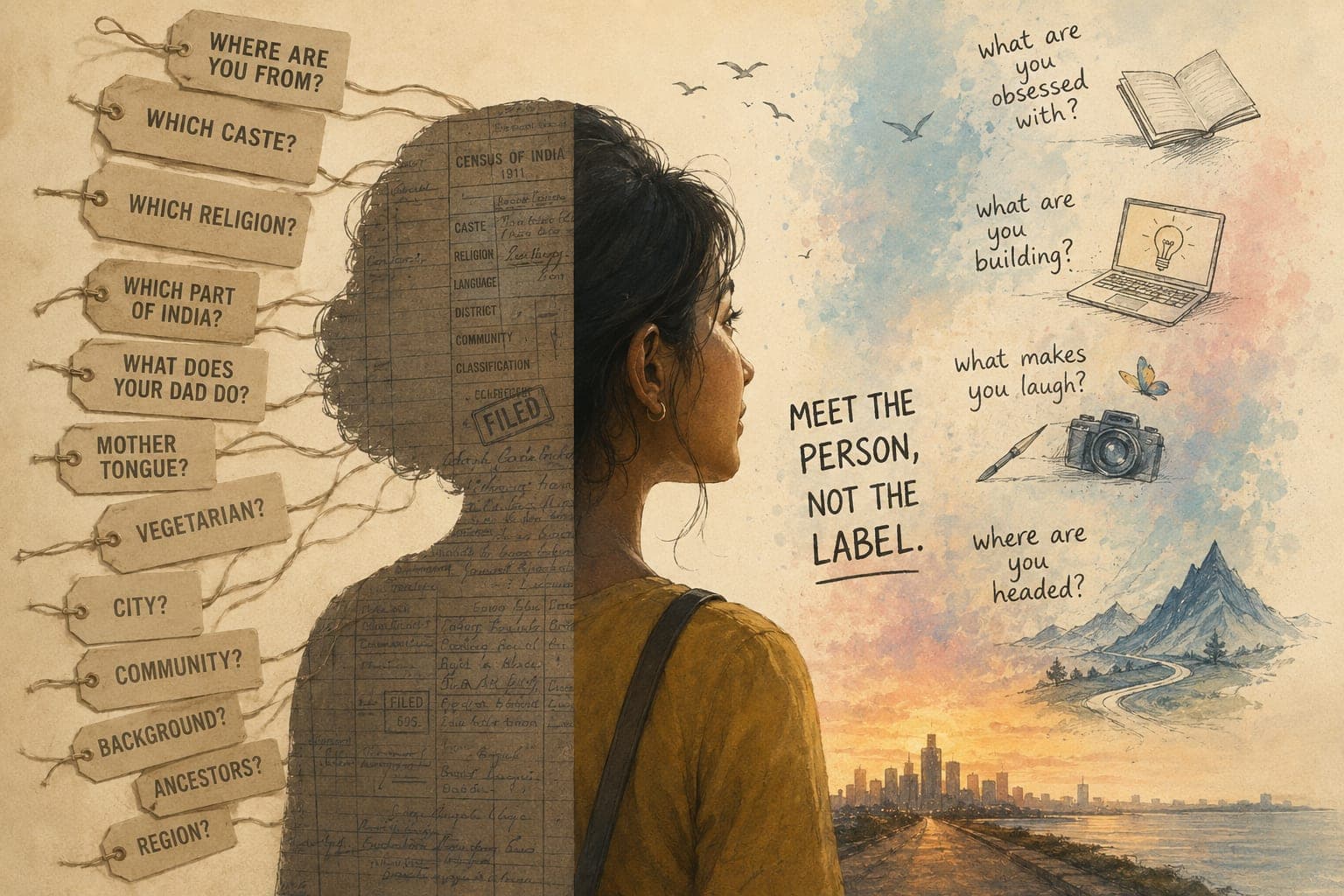
Before you ask, I am an Indian- you can tell that much from my skin colour. Now, if you are a reader from outside India, we are good till here. But if you are an Indian reading this, I know the next obvious question you have in mind is, “So, which part of India are you from?” And I can’t be vague with the answer, like, “I am from North India.” It has to be as specific as the city I belong to. For Indians, the size of the city defines the personality of the individual. And if it is someone 50+ you are talking to, the next obvious question will be, “Which caste do you belong to?” Because somehow, my ancestors define how you will look at me.
If you are annoyed reading it till here, either you are the one who has faced the same or the one who frequently asks these questions. Either way, I would like you to keep reading.
Somewhere in that first four minutes, without either of you quite noticing it happen, you’ve been placed. Region. Mother tongue. Probable religion. Filed and cross-referenced, all before the other person has learned a single true thing about what you think, what you love, or what makes you laugh. It’s rarely done outright, because outright would sound like exactly what it is: an intrusion wearing the mask of interest.
We like to think of this sorting as a way to start the conversation, the icebreaker. It isn’t, though! Not in the rigid form we’ve inherited. A good deal of what now feels like unquestionable tradition is, in truth, a little over a century old and thoroughly bureaucratic- colonial census officers spending decades trying to count, rank, and register caste into neat, comparable categories, at one point literally measuring skulls and noses to sort people “scientifically” into a fixed ladder of merit. What had been regional, layered, and locally negotiable got flattened into one national hierarchy, numbered and filed for administrative convenience. We inherited the ladder. Most of us were never told it was built by a clerk with a quota, not handed down by history itself.
That information matters because it changes what the question is actually doing. You are not tapping into ancient cultural wisdom when you ask a stranger their surname. You’re running a hundred-year-old filing system on a living person.
Here’s the part worth sitting with. Caste, region, religion, class, these are things that happened to you before you had any say in the matter. They are facts of birth, not evidence of character. And yet we treat them as forecasts, as though where your grandfather was born tells a stranger something true about your sense of humour, your ambition, your capacity for kindness.
It doesn’t. It never did. Mistaking inheritance for identity isn’t a charming cultural quirk — it’s a small, everyday failure of thought, dressed up convincingly as curiosity.
That failure doesn't stay confined to living rooms. It shows up in rental listings that specify "vegetarian only" and mean something far more specific than diet. It shows up in matrimonial profiles that list caste before career, as though ancestry were a more reliable indicator of compatibility than character ever could be. It shows up in the quiet arithmetic of whose surname gets a callback and whose doesn't. I've watched entire relationships get decided in the time it takes to exchange two surnames - how warmly to smile, how much respect to extend, whether it's worth finding out anything else. Once the credential clears, most people just stop looking. The actual person, what they're building, what they're curious about, what keeps them up at night, never gets asked for, because the room has already decided it knows enough.
On my recent trip to India, someone judged me by my attire and asked the question, "Where are you from, followed by what your dad do?" The question arrived before "what are you working on" or "where are you headed" ever got a turn. In fact, I tried to drive the conversation toward the kind of work I do. But somehow, this person was least interested in my work and more in giving me respect because my father is a retired government officer.
None of this makes curiosity the enemy - a real question, asked after two honest sentences, is a gift. The problem was never being asked where you're from. It's being asked before anything else. So here's the small refusal worth practising: the next time someone opens with your surname, don't hand over your credentials. Tell them what you're obsessed with lately, what you built this year, what made you laugh this morning. Make them work for the label. Make them meet the person before they ever get to the file.