
I barely know any women in my circle who haven’t experienced period pain. It’s just much worse for some than it is for others.
And with that pain often come cancelled plans, missed meetups, calling in sick at work, getting annoyed at someone for simply breathing too loudly and that urge to lock yourself in a room until everyone stops being annoying. Or maybe the last one is just me!
You get the point. Either you have experienced it yourself or you know someone who has.
And on behalf of those of us who go through this every month, let me just say, we don’t choose this! As if the hormonal shifts weren’t enough, the pain doesn’t exactly make things easier.
So, when I came across Code Red, a Canadian dark chocolate developed specifically with menstrual health in mind, I was naturally curious. I wanted to know what went into it and whether it would actually make a difference for me. And if it did, I could already think of a few girlfriends who might appreciate a monthly subscription.
Did I just give you a Christmas present idea for all the women in your life?
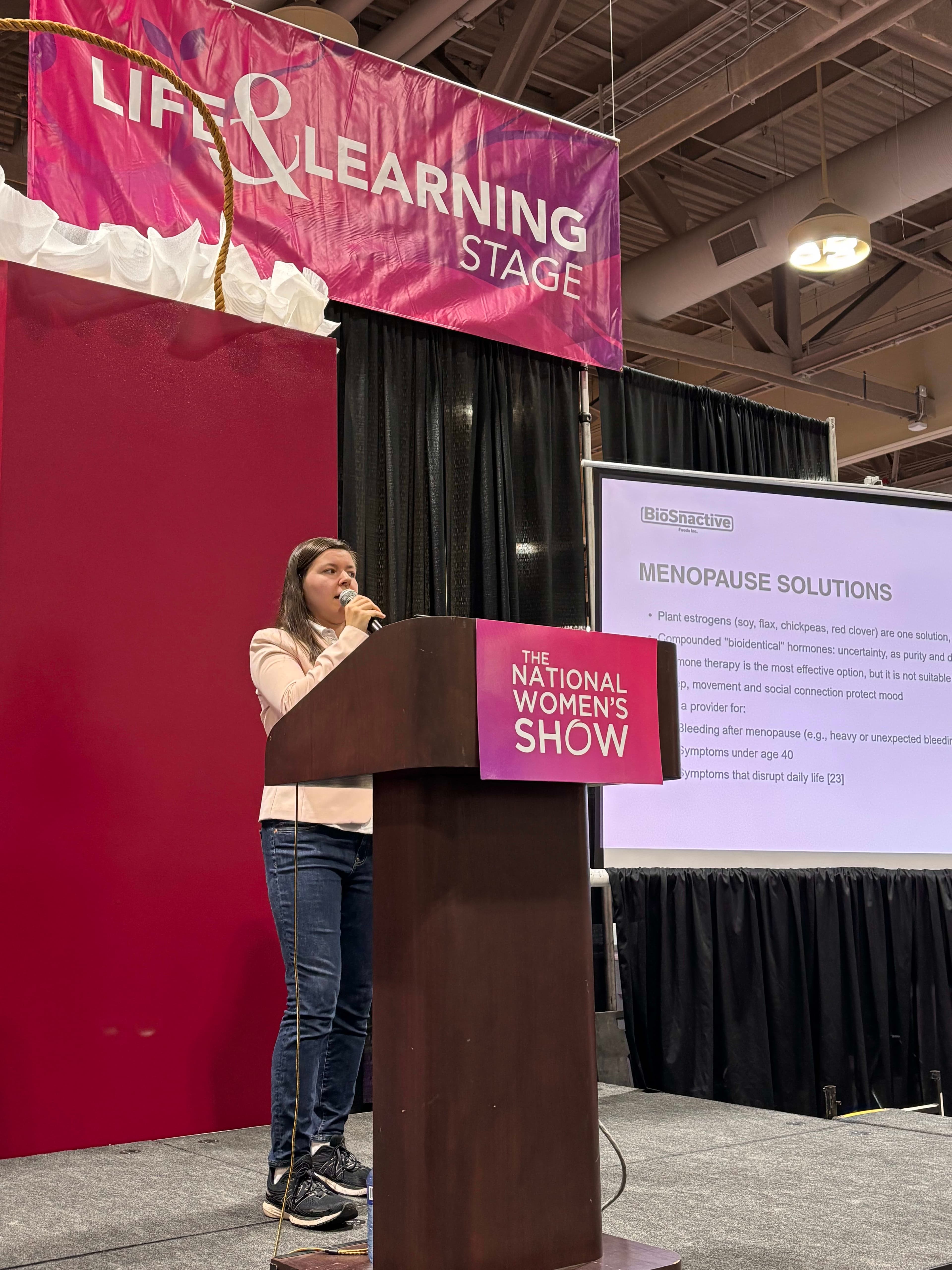
Earlier this month, I interviewed Jessica Ulbikas, the founder of BioSnactive Foods Inc. I later met her at the National Women’s Show in Toronto.
It took me a little longer than usual to write this blog because I was waiting for my period. Having experienced painful periods for years, I wanted to try the chocolate myself before writing about it.
I had one square of Code Red on the first day of my period and another on the second day. Within about half an hour of having it, I noticed a difference.
For the first time in a long time, I was able to work sitting at my desk instead of working from my bed during my period.
And the taste? It was really good. There was nothing medicinal about it. It tasted just like a good piece of dark chocolate.
Now, that’s my experience with the chocolate. Equally interesting is the story of how it came to be.
From a university project to making chocolate by hand with her mother in a commercial kitchen, Jessica has spent the last three years building BioSnactive alongside a full-time job.
And there is quite a bit to learn from how she has built this business.
It all started with a university project
We have all been there- coming up with creative ideas during our university days, only to get caught up in corporate hustle later and forget about them!
Jessica always loved food, nutrition and cooking. And decided to get her undergraduate degree in the same from the University of Guelph. But hadn't yet figured out how to bring her interests together professionally.
That changed for her during a food product development class.
Jessica and her classmates, all women in her project group, were tasked with developing a food product. They started looking for a problem they could all relate to. Menstrual pain was one of them. And reaching for chocolate during their periods was something they could all relate to..
Combining the two seemed quite natural.
Interestingly, the first version of their chocolate contained CBD (a non-intoxicating chemical compound found in cannabis and hemp plants), an ingredient that is not part of Code Red today. The project ended with the class.
What stayed with her was the experience of creating something from scratch.
"I love making something and bringing it to life."
Years later, while pursuing her master's in Human Health and Nutritional Sciences at the University of Guelph, Jessica returned to the idea. Having experienced painful periods herself, she wanted to explore whether that classroom concept could become a product people would actually need and want to buy.
The award-winning cake pops that never became a business
While reading about Jessica before our conversation, I came across another interesting product she had developed during her university years.
In 2023, Jessica and her friends participated in the University of Guelph's Project SOY Plus competition. Their entry, Nutri-Secure, was a range of plant-based cake pops made using upcycled fruits and vegetables. The idea was to address food waste while directing a portion of potential proceeds towards tackling food insecurity.
Developing a plant-based cake pop with a filling involved considerable research and experimentation. The team stayed up until around one in the morning before the expo, preparing their samples.
The project won silver.
This could have been a business!
Jessica loved the concept and what they had created, but she didn't see a practical way to commercialize the product. She was happy to leave it as a successful university project.
I found that decision particularly interesting.
When you have invested considerable time in developing something and received recognition for it, it can be tempting to believe that turning it into a business is the obvious next step. But a good product idea and a commercially viable business are two different things.
The experience wasn't wasted either. The research, product development and pitching were all skills she would eventually draw upon while building BioSnactive.
Building a business without a business background
How do you go from knowing how to create a product to knowing how to build a business around it?
Jessica’s learning came through three entrepreneurship programs at the University of Guelph’s John F. Wood Centre.
- The first was designed for people interested in entrepreneurship but who hadn’t necessarily figured out what business they wanted to build.
- The second helped entrepreneurs validate their ideas and understand whether there was a genuine demand for what they wanted to create.
- The third focused on preparing a business for launch, including marketing, branding and finances.
Apart from business training and mentorship, she also received some financial assistance to support her early research and development trials, product samples and promotional materials.
Jessica bring her understanding of nutrition and learn the commercial aspects of developing a product along the way.
Her mentorship didn’t end when she left university either. She later joined Boundless Accelerator, formerly known as Innovation Guelph, and continues to meet with one of the first mentors she encountered through the university program.
I liked that her relationship with her mentor had continued through different stages of her business.
We often associate startup support with funding, but having access to someone who understands your business and has witnessed its growth over the years can be equally valuable.
For anyone in Ontario considering starting a business, the John F. Wood Centre and Boundless Accelerator are worth exploring for their entrepreneurship programs and resources.
What goes into making chocolate for menstrual pain?
Growing up in India, one of the things I learned to make for myself during painful periods was ginger tea. Grate some fresh ginger into boiling water, let it simmer for a few minutes and sip it warm. The ginger helps with the pain. My reason for not having it more often? It's not chocolate! That, and making it requires me to get out of bed!
But Jessica's approach to developing Code Red came from her background in nutritional science. While studying nutrition, she had learned about micronutrients, macronutrients and naturally occurring compounds in food. Their specific relationship with menstrual pain was something she explored while researching her product.
She eventually settled on three key nutrients for Code Red:
- Magnesium: Contributes to normal muscle function, including muscle contraction and relaxation.
- Calcium: Plays an important role in normal muscle function and nerve signalling.
- Vitamin D3: Helps the body absorb calcium.
Jessica also had to work out which ingredients could realistically be incorporated into it and in what quantities, without compromising its taste or texture.
Cinnamon, for instance, was something she considered during her research. Some studies have explored its potential role in managing menstrual pain, but the quantities she was considering made it impractical to include in the chocolate.
There were several ingredients, combinations and quantities to experiment with. She also had to consider Canadian food regulations and the nutritional claims she could make on the packaging.
And, of course, the chocolate still had to taste good!
That last part, having tried it myself, is something I think Jessica got right.
Is Code Red a chocolate, a supplement or a medicine?
Unlike a regular bar of dark chocolate, Code Red is not something you should finish in one sitting simply because you enjoy the taste.
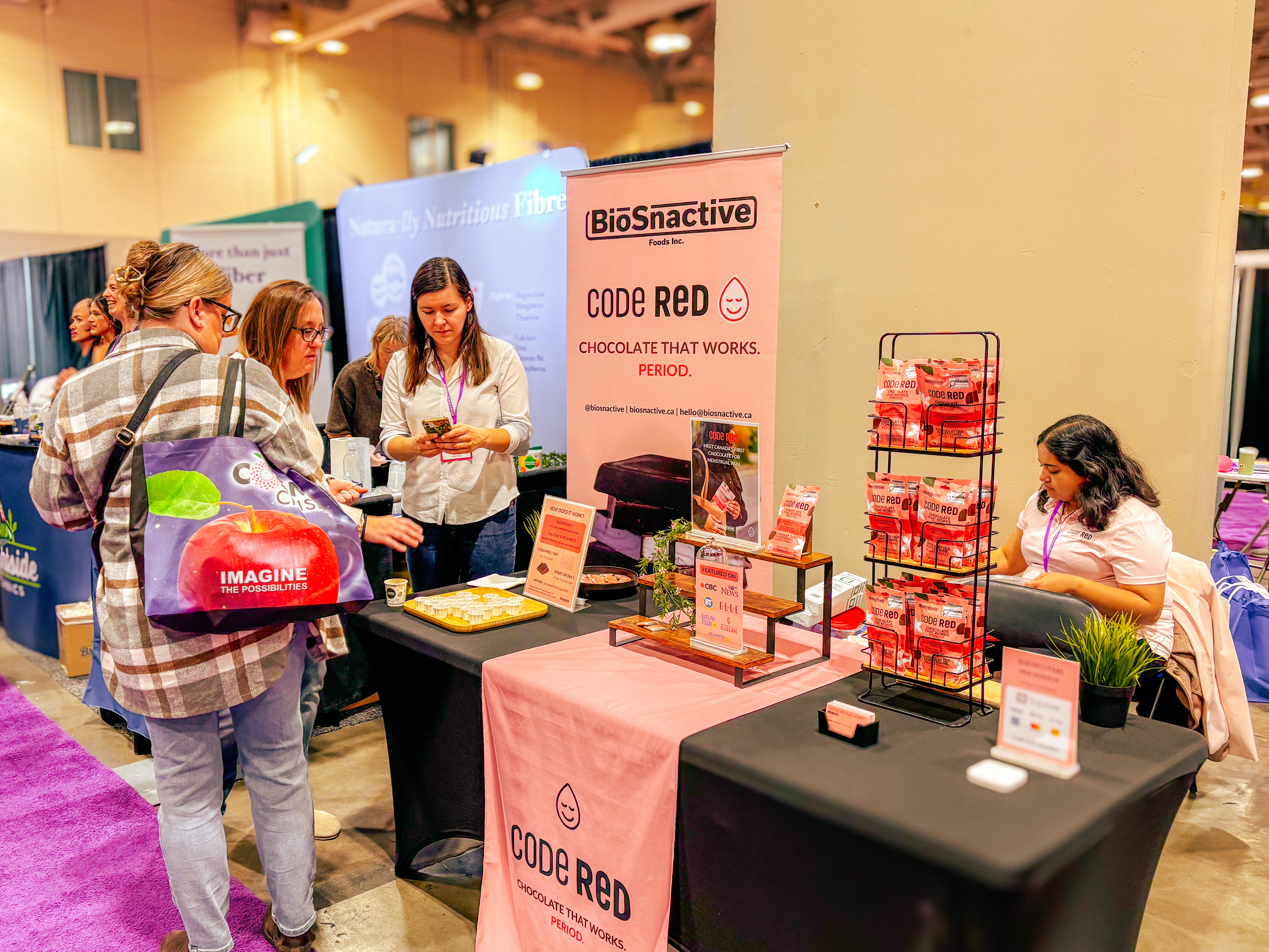
Code Red as a functional chocolate. Under Canadian food regulations, it falls into the category of supplemented foods.
Each pouch contains ten individually wrapped squares, with a serving of two squares per day. The pouch is designed to last five days.
Jessica also clarified that she does not claim the chocolate will cure menstrual pain. Its stated nutritional benefit is contributing to normal muscle function.
There is ongoing research into the relationship between nutrition and menstrual pain. A 2025 systematic review, for example, found that vitamin D supplementation may help reduce primary menstrual pain, although the certainty of the available evidence was low.
Jessica acknowledged that people’s experiences vary. She personally notices a reduction in her pain after consuming it for a few days, while some customers have reported noticing a difference sooner.
My own experience was positive, but that doesn’t establish how the product will work for someone else.
For those interested in understanding supplemented foods better, Health Canada’s guide to supplemented food labels is a useful resource.
Here is my favourite part from Jessica’s Entrepreneurial Journey!
Throughout 2024, most of 2025 and into 2026, Jessica was making Code Red by hand with her mother.
Living in Mississauga, the two would travel to a commercial kitchen in Guelph once or twice a month to make the chocolate.
And Jessica was doing all of this alongside a full-time job.
She works as a project manager at the Guelph Food Innovation Centre, where she is involved in projects related to food testing, shelf life and nutritional information.
Although her professional experience gave her an understanding of food production, putting that knowledge into practice for her own business was an entirely different experience.
Chocolate is particularly sensitive to temperature and moisture. A variation of just a few degrees can affect its texture and whether it has that familiar snap when you break a piece.
Then there was the cleaning, maintaining hygiene standards, getting consistent results across batches and preparing the products for sale.
Even on one of their best production days, after working practically the entire day, she and her mother managed to produce around 150 units.
Imagine doing that and then having to answer customer emails, attend farmers’ markets, maintain a website, market the product and go back to your full-time job.
BioSnactive now works with a chocolate manufacturer in Kitchener, Ontario. The manufacturer’s minimum production scale is around 1,000 units a day. For a business that had previously depended on two people making chocolate by hand, that is a considerable change.
Now that that Code Red is commercially manufactured, participating in some of the artisan markets, requiring vendors to make their own products, are not an option anymore.
Jessica now wants to focus more on retail partnerships and other ways of reaching customers.
You learn from your customers!
One of the changes Jessica made to Code Red came directly from customer feedback.
Originally, the chocolate squares were placed loose inside a pouch that opened from the side. Customers pointed out that the packaging wasn’t particularly convenient once opened, especially when they only wanted to consume a couple of squares at a time.
Today, each chocolate square is individually wrapped inside the pouch, making it easier to carry a piece or two without bringing the entire pack along.
It is a relatively small change, but one that improves how customers actually use the product.
Until now, Jessica has gathered much of her customer feedback through conversations at markets and occasional messages.
Where to buy Code Red chocolate in Canada
As of today, Code Red is listed at $10.99 CAD per pouch on the BioSnactive website.
Each pouch contains ten squares, or five daily servings according to the product instructions. That works out to approximately $2.20 per recommended daily serving, before shipping and applicable taxes.
Code Red is currently listed at the following retail locations in Ontario:
- Double Rainbow Café, Guelph
- Benjamin’s Bodega, Guelph
You can also purchase it directly from the BioSnactive website, which currently ships within Ontario, including Toronto and the GTA.
Website: biosnactive.ca
Instagram: @biosnactive
Before trying Code Red, read the product’s consumption instructions and caution statements. The company specifies a maximum of two squares per day and advises against its consumption by people under 14, those who are pregnant or breastfeeding, and people sensitive to caffeine. There are also restrictions on combining it with other supplemented foods or supplements containing the same added nutrients.
If menstrual pain regularly interferes with your everyday activities, speak with a healthcare professional to understand its underlying cause.
Some problems deserve more attention than we give them
Her advice to aspiring entrepreneurs:“You have to be in it for the long haul. It’s not something you’re gonna work on for a few months and hopefully it takes off. It’s long dedication, but if you’re passionate about it, you can make it work.”
As someone building Under the Wraps, I understood that feeling, too.
Sometimes, it takes just one conversation, one piece of feedback or one person who finds value in what you are doing to remind you why you started.
I hope I get to revisit Jessica’s story in a couple of years and see what BioSnactive has become.