I didn’t plan for this list to have a theme. But once I lined up the four books I wanted to talk about this time, I noticed they are mostly the stories you might already know. Either you have experienced it, know it from mythology, or might have come across something similar in recent times. All of it makes it more relatable and gives a chance to be in your TBR for this year.
But why do I want you to read it in the second half of the year?
Well, I am not hell-bent on it! You can always read it next year (yes! we are just 4 months away from 2027). But the second half of the year is my favourite; evenings ask for a blanket, commutes get a little more contemplative, and a TBR list starts to feel appealing again.
Here are my recommendations:
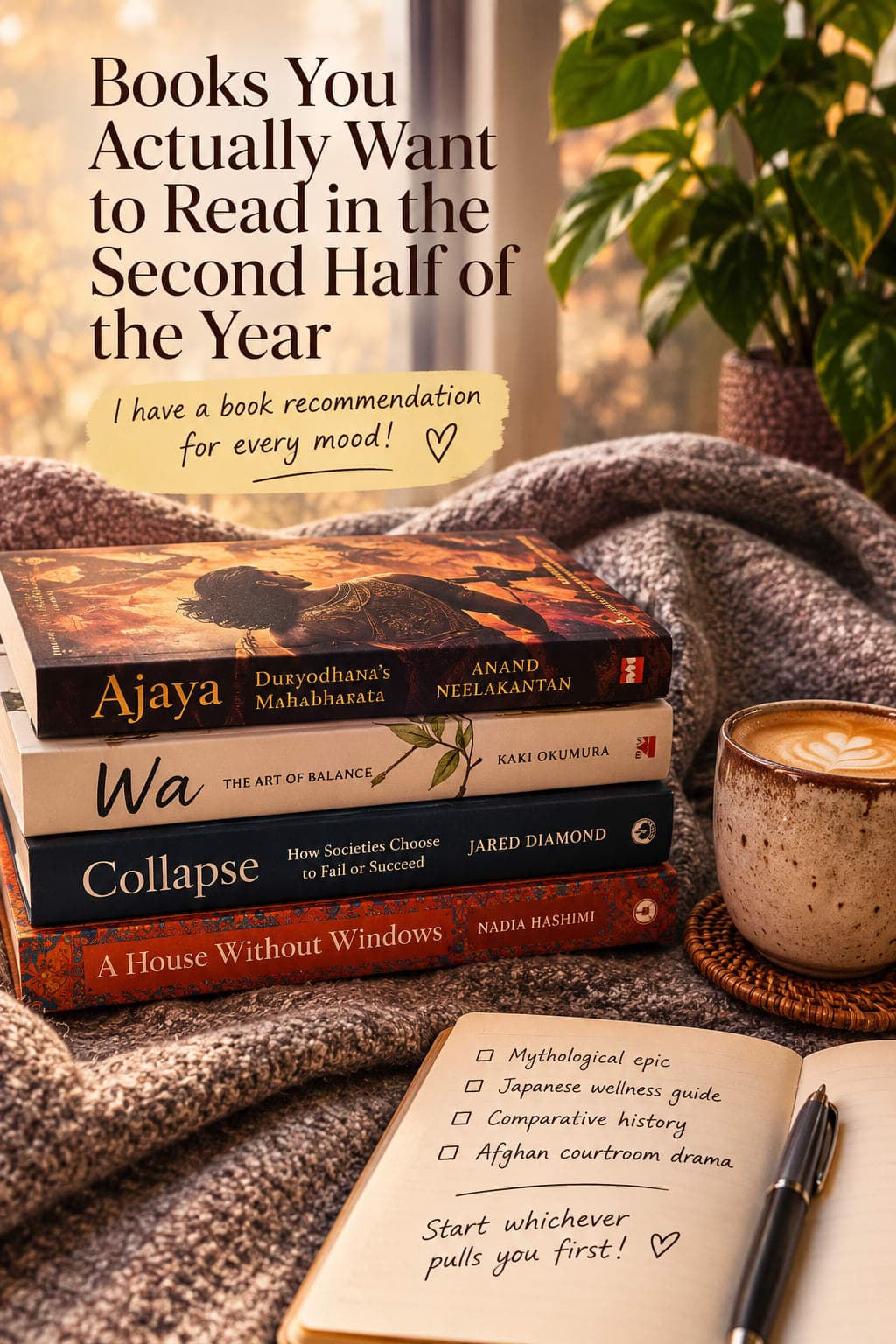
1. Ajaya - Duryodhana's Mahabharata
I had a lot of arguments with the book while reading it! Yes, it is conversational that way.
Every culture has its official villain, and in Hindu Mythology, the Mahabharata, that's Duryodhana- the Kaurava prince blamed for the war that tears two branches of one family apart. Anand Neelakantan, the author behind Ajaya, started questioning that reputation on a visit to a temple in Kerala, where he found Duryodhana worshipped as a deity, not condemned as one. Ajaya is what came out of that question: the entire epic retold from inside Duryodhana's head. A boy denied his birthright to a king convinced he's the one keeping his word while everyone around him bends the rules.
This collector's edition bundles both books in the series: Roll of the Dice and Rise of Kali, into one solid, 600-plus-page read, which makes it a good match for the slower pace this time of year tends to bring. You don't need to have grown up on the Mahabharata to fall into it. If you did, though, this is the version that'll send you back to reread the parts you thought you already understood.
2. Wa- The Art of Balance
The only self-care routine you need is this book!
I first discovered Kaki Okumura from her Medium blogs. I loved her blogs and subscribed to her newsletter. Didn't know she authored a book as well! I accidentally stumbled upon her book while browsing the Toronto Public Library in my area and had to get it.
If your wellness routine has quietly turned into another to-do list, Wa is the corrective. Kaki Okumura grew up between New York and Tokyo. Her book is around one Japanese concept- wa, meaning harmony- and four gentle pillars: Nourish, Move, Rest, Socialise. None of it runs on willpower. She'll tell you to eat until you're about eight-tenths full, hara hachi bu, instead of counting anything, to try three minutes instead of a workout plan, to treat a properly made cup of matcha as the point of the break rather than something to rush through on the way back to your desk.
I especially love the hand-illustrations in the book, made by Okumura herself. So it's as much a book to look at as to read, and it's built to be picked up in ten-minute stretches without losing the thread.
I was much in need of rest and a break when I picked this book. And as a hyperfunctional individual, I liked how this book didn't frame "rest" as something I have to earn first. Going into a season that tends to fill up fast with routines resetting, plans firming up, and everyone suddenly busy again, that's a genuinely useful thing to be reminded of.
3. Collapse: How Societies Choose to Fail or Succeed
Jared Diamond wrote Collapse as a follow-up to Guns, Germs, and Steel. I read the first part on a friend's recommendation. I picked the second part because I loved the first one! And it didn't disappoint either.
But it asks a far less comfortable question than its predecessor did. Not how civilisations rise, but why some of them saw the end coming and still couldn't, or wouldn't, stop it. He moves between Easter Island, the Maya, Norse Greenland, Rwanda, and, unexpectedly, modern-day Montana, circling the same conclusion each time: collapse is rarely just bad luck or a harsh environment. More often, it's a slow accumulation of choices, made by people who had more warning than we like to imagine.
This is a 600-page dense read. Not something you'll finish over a weekend. My one recommendation is to read it like a long featured column story rather than a textbook. It will change your perspective towards how the world functions. Ofcourse, a good attention span is needed to read it, instead of skimming. You can start this one in September and expect to still be turning it over by the time the year wraps up.
4. A House Without Windows
I won't lie, Instagram influenced me into picking this book and reading it. I mean, half my feed was full of every other person reading and recommending it.
The book opens with Zeba, a wife and mother of four, found beside her husband's body with a hatchet in her hand and no memory of what happened in between. She's sent to an Afghan women's prison to await trial, and that's where the real story starts, not as a courtroom drama, but as a portrait of the women locked up alongside her: a teenager pulled out of harm's way before an honor killing, a runaway with nowhere else to go, a young woman facing a pregnancy she can't explain to her family. Nadia Hashimi, the Author and a paediatrician whose own parents left Afghanistan in the early 1970s, writes every one of them with more curiosity than judgment.
It's technically a mystery; you do want to know what actually happened in that courtyard. But it's really a book about who gets believed, and why, inside a system that was never built to ask. It's the kind of novel that resists a tidy genre label and gets harder to put down once Zeba's lawyer starts asking the questions everyone else stopped asking years ago.
Start whichever pulls you first!
These four don't have much in common: a mythological epic, a Japanese wellness guide, a work of comparative history, an Afghan courtroom drama. That's sort of the point of a list like this: not a theme I set out to build, just four books that kept circling back to the same question- what do we actually know, and who told us so?
Start with whichever one pulls at you first. They don't need to be read in order, and they definitely don't need to be read back to back. Let one sit for a while if it needs to. If you end up picking one of these up, I'd genuinely love to know which one, and what it made you look at differently.