
Picture this: You're living in Toronto, and on a Saturday, the girl in you feels like going shopping and spending some bucks buying all the cute stuff. You walk into one of those home décor stores and stand there holding a $50 candle that smells faintly of "warm linen." Then there is a beige-coloured ceramic vase labelled "pebble", a best seller, available in shades of beige, royal blue, shades of brown, and some transparent ones. Standing there in the beige abyss, your mind transports you to your home country, and you hear a voice from the back of your mind, saying, "Wish I had more variety and some vibrancy in options."
This is a true story. I walked out without buying anything. But the episode got me thinking, I'm in one of the best cities in the world, surrounded by every brand imaginable, yet my eyes crave something that doesn't look machine-manufactured. Something with artistry. Something made by hand.
My Love For Indian Handicrafts
Indian handicrafts are vivid, layered, ancient and unapologetically expressive. Things are made to last for years, sometimes generations.
When I moved to Canada, I tried to assimilate. I swapped my hand-embroidered clothes for floral dresses and tucked my embroidered dupatta. A few days later, I spotted the same embroidered dupatta in a Canadian boutique, selling for nearly five times what I'd paid for it. That was my real revelation. And it explained why a ₹500 Kolhapuri chappal was being rebranded by Prada as a "toe ring sandal" and sold for 1,800 CAD.
What I had with me was considered a fashion statement here. Not because it was expensive, but because it was human-made. And that makes it different from almost anything else the world has to offer.
India has thousands of years of craft traditions. Weaving, dyeing, carving, embossing, block printing, pottery. These are not hobbies, but inherited skills, passed down through generations of artisans rooted in specific regions and cultures. When you buy something handmade in India, you're not just buying a product. You're buying someone's life's work.
Yes, you can find "Indian-inspired" things in Canada, again, mass-manufactured versions that borrow the aesthetic but lose the soul. For the "real thing", you have to visit India.
Why Canada Cannot Compete With Indian Artisans
I want to be clear: I genuinely like living in Canada. The healthcare, the safety, the customer-first culture, all of it is more than I asked for. But Canada's shopping culture has a problem nobody in retail seems willing to say out loud: it's monotonous.
Walk through any home goods store, any boutique, any "curated lifestyle space," and you'll find the same rotating palette of neutrals with slightly different names. Greige. Sand. Fog. Blush. Sage. Charcoal. The aesthetic is designed to offend no one, and as a result, it moves no one either.
Then there's the quality problem. So much of what's sold here is built for the short term. Pieces that look good for a season, photograph well, and quietly fall apart once the trend cycles away. The "artisan" pottery was clearly machine-made. The silk-look fabric turned out to be polyester.
What India offers is fundamentally different: A Banarasi weaver doesn't make fabric to match a seasonal trend. A Dhokra artisan doesn't cast metal for a mood board. A Kashmiri shawl maker doesn't source Pashmina because an algorithm flagged "softness" as trending. They make what they make because it's what their hands have always known, and that permanence is exactly what gives the work its power.
Best Things To Buy In India: A Shopaholic's Guide
Consider this less a shopping list and more a manifesto. Everything here is something I bought in India and carried back to Canada. And every single one has earned me compliments.
- Handwoven Textiles
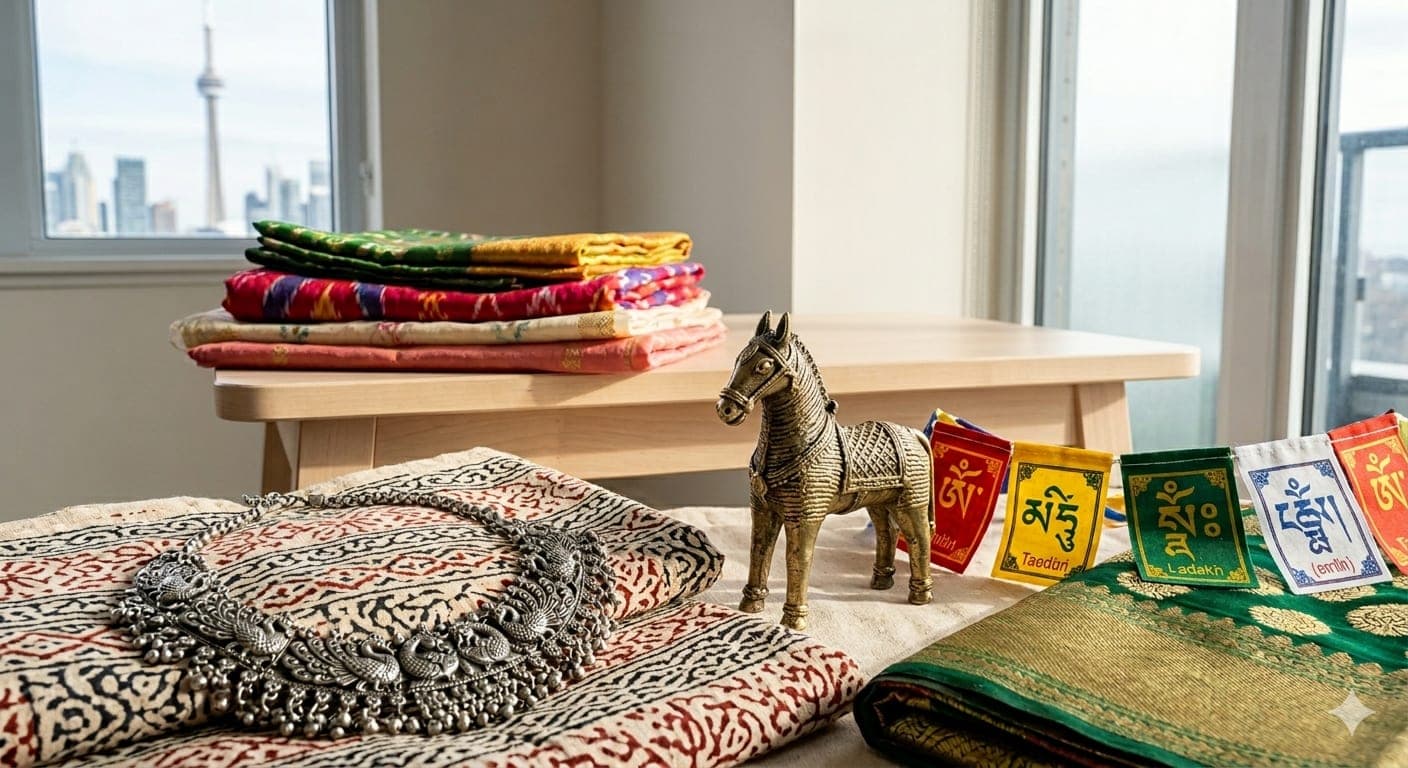
India has been known for its textiles. A Banarasi silk saree woven with real zari, gold or silver thread worked into the fabric on a handloom in Varanasi, can take a master weaver weeks to complete. A Pochampally Ikat from Telangana uses resist-dyeing, where threads are dyed before weaving, so the pattern emerges from the intersection of colour as the loom works. A Chanderi cotton from Madhya Pradesh has a translucency so delicate it's been described as "woven air."
I use mine in ways that confuse people at first and then make complete sense: draped over a sofa as a throw, stretched and framed as wall art, or laid out as a table runner where the first question at every dinner party is, "Where is that from?"
- Block Printed Fabrics
An artisan carves an intricate design into a wooden block, dips it in natural dye, and stamps it onto fabric, repeating the block until a pattern builds across the cloth. Jaipur's Sanganer and Bagru villages are the heartland of this craft, and since Jaipur is my hometown, my love for it runs deep.
- Dhokra- a 4,500-Year-Old Metal Casting Technique
This one earned me the most compliments. Dhokra is a lost-wax casting technique practised by tribal artisans in Chhattisgarh and West Bengal. A wax model is made, covered in clay, and fired until the wax melts out. Then molten metal is poured into the cavity. What emerges is a textured, one-of-a-kind object that cannot be replicated by any machine.
I have a Dhokra horse on my bookshelf. Every person who visits eventually gravitates toward it, picks it up, and turns it over. Everyone asks, Where did I get it.
- Antique Silver Jewellery
If you're buying statement jewellery, look to Rajasthan and Gujarat. Peacocks, lotuses, elephants, geometric patterns borrowed from centuries of architectural tradition, and you can buy two beautiful pieces for the price of one mediocre dinner in downtown Toronto.
- Praying Flags From Ladakh
This one is less a shopping recommendation and more an invitation to carry something meaningful home. In Tibetan Buddhism, prayer flags promote peace, compassion, strength, and wisdom. They aren’t directed toward any god but are believed to spread positive energy through the surrounding environment. Hung above ground where the wind can reach them, they’re one of the first things people notice when they walk into my home, and always the first thing they ask about
This Isn't Just About Shopping!
If you've followed this space for a while, you'll know I'm not particularly driven by shopping. I'd rather spend a day with a book or wandering through a neighbourhood.
So why write this?
Because here's what I've understood after years of building a home across different corners of the world: a home is not something you fill with objects, and shopping is not about spending money on what's trending.
Everything you wear, display, or surround yourself with carries weight, not just physical, but cultural. The weight of choice and intention.
I don't bring things from India to decorate a space. I bring them to stay connected to the artisan who made them, to a tradition that has survived centuries, and to a part of myself that no neutral-toned store shelf can reach.
I love Canadian stores for their convenience. But for everything my senses truly want, Indian markets are where I belong. And there's a particular pride in owning something that exists nowhere else in the world.